
💧 Sous Vide Recipes
Visit our Contact Page to find out how you can contribute your favorite recipes.

💧 Sous Vide Recipes
| Sous Vide Poached Eggs 🌄 💤 ⏳ |
| Herb Roasted Lamb Chops 🌄 💤 ⏳ |
| How To Pasteurize Eggs Using Sous Vide - With Some Caveats 🌄 💤 |
| Lemon - Onion Barbecue Chicken 🌄 💤 ⏳ |
| Sous Vide Ribs 🌄 💤 ⏳ |
| How to Make A Bunch of Poached Eggs Ahead of Time 🌄 💤 ⏳ |
| Pot Roast for Crock Pot or Sous Vide 🌄 💤 ⏳ |





Ingredients
eggs
sous vide machine
water
Directions
The general consensus is to set your sous vide machine to 75C/167F.
Once the temperature is reached, gently place the whole eggs, in their shells, in the bath using a slotted spoon.
Times ranged from 13 to 14 minutes. I think 14 minutes is better.
Remove eggs from the sous vide bath with the slotted spoon once the timer goes off.
DO NOT wait. Even a minute can make a difference.
Place the eggs into a bowl of ice water for 5 minutes to set the whites.
Both recipes suggest cracking the egg around the middle, in a slotted spoon to allow excess egg white to drain. I cracked mine closer to the top and the egg kind of "plopped" out.
Servings\Yield
Serves as many as you need
Nutrition Facts
Nutrition Per Serving (1 egg) - Calories: 70; Total Fat: 5g (Saturated Fat: 1.5g); Cholesterol: 185mg; Sodium: 70mg; Total Carbohydrates: 0g (Dietary Fiber: 0g, Sugars: 0g); Protein: 6g
*Nutrition information is provided as a general estimate only. Nutrient information is not available for all ingredients, and is based on available nutrient data. Variations may occur based on ingredient brands and preparation methods.
💬 Uncle Dave says...
I used several different sources for this information:
Sous Vide Sideways and Allrecipes are two of them.
Visit How To Make A Bunch of Poached Eggs Ahead of Time for how to store them.
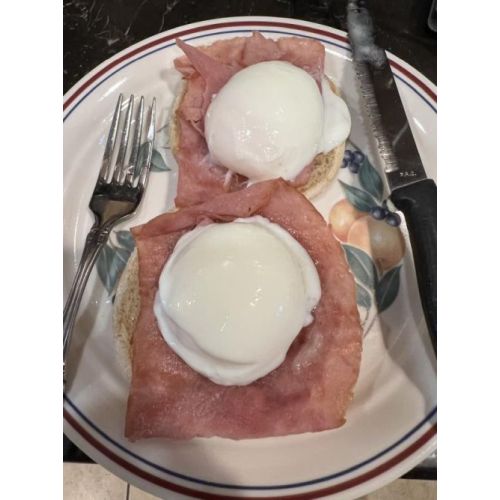
The images are the results of my first effort. They look better than they were. They were waaaay too runny, even for a guy like me who likes them runny.
I went 13 minutes; should have gone 14, or even 15.
I only left them in the ice bath about 2 minutes.
Getting the shell off without leaving a lot of little shell pieces was a pain in the ass.
Having said that, I think if you had to do a lot of poached eggs, this might be a solution.
🧑🍳 The Cook:
Dave Ferguson
🔑 Keywords:
poached eggs,
sous vide,
breakfast
🗂️ Categories: 🥞 Breakfast & Brunch, 💧 Sous Vide
📚 Collections: The TFR Cookbook
Sous Vide Poached Eggs was added on July 16, 2023 and last updated on May 08, 2026.
🗂️ Categories: 🥞 Breakfast & Brunch, 💧 Sous Vide
📚 Collections: The TFR Cookbook
Sous Vide Poached Eggs was added on July 16, 2023 and last updated on May 08, 2026.
*Serving suggestion only. 😂 If a food photo doesn't look like it was taken by a monkey named Frank, it was most likely AI generated and not the result of Frank's minimal culinary or photographic skills. Unless you failed the "I'm not a robot" test, your recipes will probably not look like the ones in the pictures. See Creamy Turkey Veggie Soup to read more about AI images.
📄 A Quick Note About The Recipes At The Ferguson Recipes: We love sharing recipes, but please be aware that most haven't been professionally tested in our kitchen or independantly verified. Your safety is important to us, so always practice safe food handling and cooking techniques. Cook smart and use your best judgment! Eggs: If you make a recipe that uses raw eggs, please consider using pasteurized eggs. Allergens: Food allergens have not been identified in each individual recipe. Please use caution if you have any food allergies. Have questions about a specific recipe? Feel free to reach out to us.
💡️ Cookie Policy, Privacy Policy, Disclaimers, and Terms of Service
🍪 Cookie Policy: Cookies are only used for registered users for the keep logged-in function, if you select it. They are also used to let us know that you don't want cookies set. Ironic, ain't it!
🤐 Privacy Policy: I don't share your information with anyone; I don't even know how!
📜 Terms of Service: Be nice!
ℹ️ About TFR: Click me to learn more about The Ferguson Recipes!
🏛️ Founded April 13, 2006
©️ 2006 - 2026 fergusonrecipes.com
📧 Contact!
🤐 Privacy Policy: I don't share your information with anyone; I don't even know how!
📜 Terms of Service: Be nice!
ℹ️ About TFR: Click me to learn more about The Ferguson Recipes!
🏛️ Founded April 13, 2006
©️ 2006 - 2026 fergusonrecipes.com
📧 Contact!
📄Recipe Disclaimer: While The Ferguson Recipes strives to present reliable and delicious recipes, please note that most of the recipes on this site have not undergone rigorous testing or independent verification. For this reason, we strongly recommend that you always follow standard food safety guidelines when preparing any dish. Eggs: If you make a recipe that uses raw eggs, please consider using pasteurized eggs. Allergens: Food allergens have not been identified in each individual recipe. Please use caution if you have any food allergies. If you have any questions or concerns about a specific recipe, please feel free to contact us.
🔎️ About Searches
- ‼️ Please enter at least 3 characters with at least 1 letter. (50 character limit.)
- 🍏 Use quotes for exact match (e.g.,"apple pie")
- 🍲 Use + to require words (e.g.,+chicken +rice)
- 🥩 Use | for "OR" (e.g., beef|chicken)
- 🚫 Use - to exclude (e.g., chocolate -nuts)
- 🌟 Use * as a wildcard (e.g., chick*)
- 🥣 Combine filters
- 🥣 Try (e.g., +Mexican +taco* -rice)
- 🥣 or (e.g., +"green beans" +ferguson)
- ⚠️ Some special characters might be ignored.
- 🍪 Search by category (e.g., sweets|cookies)
- 🧂 Search by ingredient (e.g., cinnamon, nutmeg)
- 🔍 Try multiple words for better results
- 🛑️ NOTE: One or more "-" without anything else will find no recipes.
- ⚠️ Occasionally, the highlighting process breaks due to embedded hyperlinks, some wierd characters, some weird punctuation, sun spots, acne spots, etc. Nowt to be done about it.
✖
![Zoomed image]()