

The Ferguson Recipes
| Buckwheat Pancakes - Claude's Version 🌄 💤 ⏳ |
| Buckwheat Pancakes - Gem's Version 🌄 💤 ⏳ |
| Buckwheat Pancakes - Petey's Version 🌄 💤 ⏳ |
| Budae Jjigae (Army Base Stew) 🌄 💤 ⏳ |
| Buffalo Chicken Dip 🌄 💤 |
| Burnt Sugar Caramel Pie 🌄 💤 ⏳ |
| Burrata with Crushed Cherries and Pistachios 🌄 💤 |
| Butter and Jam Thumbprints 🌄 💤 |





Ingredients
3/4 cup (100g) buckwheat flour
3/4 cup (100g) all-purpose flour
3 tablespoons sugar
1/2 teaspoon salt
1 teaspoon baking soda
1 egg, optional
Up to 2 cups (475 ml) buttermilk, depending on consistency.
3 tablespoons (42g) unsalted butter, melted and cooled slightly
Vegetable oil for coating the pan
Directions
Heat a well-seasoned griddle, cast iron skillet, or stick-free pan on medium heat.
The pan or griddle should be ready for the batter as soon as it is mixed.
Whisk together the dry ingredients—the flours, sugar, salt, baking soda—in a large bowl.
Beat the egg with a fork and stir it into half of the buttermilk.
Add the melted butter and stir.
Add the egg mixture to the dry ingredients, then slowly add more buttermilk as needed to get a thick but pourable consistency for your batter.
Stir only until everything is combined. Do not over-mix! A few lumps are fine.
Put a small amount (1/2 teaspoon) of vegetable oil on the pan or griddle and spread it around with a paper towel to coat.
Ladle the batter onto the hot surface to the desired size, about 4 to 5 inches wide.
Reduce the heat to medium-low.
Allow the pancake to cook for 2 to 3 minutes on this first side.
When air bubbles start to rise and pop on the surface at the center of the pancake, flip the pancake.
Cook for another 1 to 2 minutes, or until nicely browned.
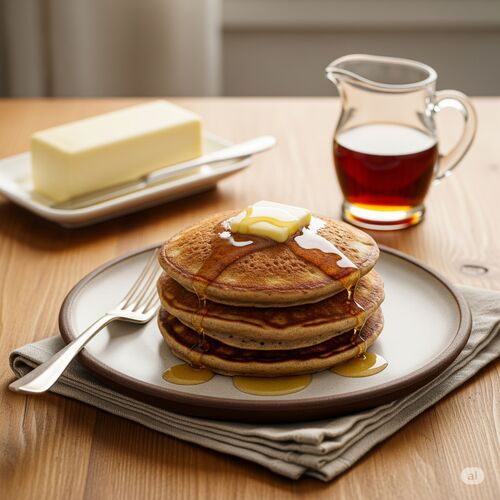
Serve with butter and hot maple syrup. HOT maple syrup can make or break a pancake!
Servings\Yield
Makes about 12 four-inch pancakes (serves 3-4 people)
Nutrition Facts
Nutrition Per Serving (3 pancakes) - Calories: 330; Total Fat: 12g (Saturated Fat: 6g); Cholesterol: 75mg; Sodium: 570mg; Total Carbohydrates: 48g (Dietary Fiber: 4g, Sugars: 12g); Protein: 9g
*Nutrition information is provided as a general estimate only. Nutrient information is not available for all ingredients, and is based on available nutrient data. Variations may occur based on ingredient brands and preparation methods.
💬 Uncle Dave says...
LOOK AT THE TOP TO SEE THE "BLURB" BY AI ⬆️
Yes, I have three identical recipes for Buckwheat Pancakes. And here is why.
I have semi-automated the way I can add recipes to the website using AI, or in this case, three AIs: Claude, Gemini, & ChatGPT.
All three of them have project files with instructions on how to process the recipe data.
All three of them have project files with instructions on how to process the recipe data.
If someone sends me a recipe, or I see one I like online*, I can enter the recipe name, ingredients, and cooking instructions into any one of the three AIs' chat boxes.
I have given the AIs instructions to properly format those three things, and to extrapolate a few things on their own: keywords to use, serving sizes, and what I call the "blurb", which is the hopefully appealing description of the recipe that you see at the top of the page. Along with some other internal data that is preprogrammed into the instructions. the AI then presents the results in a way that allows me to paste everything into the recipe database in one big block.
So why are there three of the same one? I wanted to see how each AI handled them.
So why are there three of the same one? I wanted to see how each AI handled them.
The Results:
1) Blurbs - some were better than others. Claude is the best. It makes the recipe sound appealing and fun. ChatGPT is the worst; too short for one thing.
2) Serving sizes - all reasonably close to the same. Again, I like the way Claude worded it the best.**
3) Keywords - all three picked the exact same four keywords!
* Before anyone gets all worked up, recipe ingredients and cooking directions are not copyrightable. Having said that, the AIs have been instructed to remove anything that personalizes a recipe, such as, "My granny used 3 cups, but I only use 2 3/4." And I manually change the name of a recipe when I give it to the AI if I think it needs to be made more generic.
** I discovered recently that many of the recipes had nothing in the serving size or said things like "Unknown" "Serves Many" or just "Serves". I put Claude AI to work on those. Many of the more verbose "Serving Size" entries are Claude's.
🧑🍳 The Cook:
Dave Ferguson
🔑 Keywords:
buckwheat,
pancakes,
breakfast,
buttermilk
🗂️ Categories: 🥞 Breakfast & Brunch, 🧒 Foods Kids Love
📚 Collections: Uncle Dave's Cookbook, The TFR Cookbook
Buckwheat Pancakes - Claude's Version was added on April 08, 2025 and last updated on July 07, 2025.
🗂️ Categories: 🥞 Breakfast & Brunch, 🧒 Foods Kids Love
📚 Collections: Uncle Dave's Cookbook, The TFR Cookbook
Buckwheat Pancakes - Claude's Version was added on April 08, 2025 and last updated on July 07, 2025.
*Serving suggestion only. 😂 If a food photo doesn't look like it was taken by a monkey named Frank, it was most likely AI generated and not the result of Frank's minimal culinary or photographic skills. Unless you failed the "I'm not a robot" test, your recipes will probably not look like the ones in the pictures. See Creamy Turkey Veggie Soup to read more about AI images.
📄 A Quick Note About The Recipes At The Ferguson Recipes: We love sharing recipes, but please be aware that most haven't been professionally tested in our kitchen or independantly verified. Your safety is important to us, so always practice safe food handling and cooking techniques. Cook smart and use your best judgment! Eggs: If you make a recipe that uses raw eggs, please consider using pasteurized eggs. Allergens: Food allergens have not been identified in each individual recipe. Please use caution if you have any food allergies. Have questions about a specific recipe? Feel free to reach out to us.
💡️ Cookie Policy, Privacy Policy, Disclaimers, and Terms of Service
🍪 Cookie Policy: Cookies are only used for registered users for the keep logged-in function, if you select it. They are also used to let us know that you don't want cookies set. Ironic, ain't it!
🤐 Privacy Policy: I don't share your information with anyone; I don't even know how!
📜 Terms of Service: Be nice!
ℹ️ About TFR: Click me to learn more about The Ferguson Recipes!
🏛️ Founded April 13, 2006
©️ 2006 - 2026 fergusonrecipes.com
📧 Contact!
🤐 Privacy Policy: I don't share your information with anyone; I don't even know how!
📜 Terms of Service: Be nice!
ℹ️ About TFR: Click me to learn more about The Ferguson Recipes!
🏛️ Founded April 13, 2006
©️ 2006 - 2026 fergusonrecipes.com
📧 Contact!
📄Recipe Disclaimer: While The Ferguson Recipes strives to present reliable and delicious recipes, please note that most of the recipes on this site have not undergone rigorous testing or independent verification. For this reason, we strongly recommend that you always follow standard food safety guidelines when preparing any dish. Eggs: If you make a recipe that uses raw eggs, please consider using pasteurized eggs. Allergens: Food allergens have not been identified in each individual recipe. Please use caution if you have any food allergies. If you have any questions or concerns about a specific recipe, please feel free to contact us.
🔎️ About Searches
- ‼️ Please enter at least 3 characters with at least 1 letter. (50 character limit.)
- 🍏 Use quotes for exact match (e.g.,"apple pie")
- 🍲 Use + to require words (e.g.,+chicken +rice)
- 🥩 Use | for "OR" (e.g., beef|chicken)
- 🚫 Use - to exclude (e.g., chocolate -nuts)
- 🌟 Use * as a wildcard (e.g., chick*)
- 🥣 Combine filters
- 🥣 Try (e.g., +Mexican +taco* -rice)
- 🥣 or (e.g., +"green beans" +ferguson)
- ⚠️ Some special characters might be ignored.
- 🍪 Search by category (e.g., sweets|cookies)
- 🧂 Search by ingredient (e.g., cinnamon, nutmeg)
- 🔍 Try multiple words for better results
- 🛑️ NOTE: One or more "-" without anything else will find no recipes.
- ⚠️ Occasionally, the highlighting process breaks due to embedded hyperlinks, some wierd characters, some weird punctuation, sun spots, acne spots, etc. Nowt to be done about it.
✖
![Zoomed image]()