

The Ferguson Recipes
| Hot Salmon Dip 🌄 💤 ⏳ |
| Hot Smoked Salmon Bagel 🌄 💤 |
| Hot Tea Punch 🌄 💤 ⏳ |
| How To Boil Eggs Perfectly Every Time 🌄 💤 ⏳ |
| How to Cook Pasta 🌄 💤 ⏳ |
| How to Make A Bunch of Poached Eggs Ahead of Time 🌄 💤 ⏳ |
| How to Make Beurre Monté 🌄 💤 |
| How to Open and Clean a Pismo Clam 🌄 💤 ⏳ |





Ingredients
1 Tbsp water for every 4 Tbsp butter❗ (This should be enough for 2 pounds of vegetables).
Salt and pepper to taste
Other seasoning as desired.
❗Cut butter into 1/2 Tbsp pieces and keep in refrigerator until right before you add them to the water.
Directions
🎯Gradually whisking pieces of cold butter into warm liquid is key to a stable emulsion.
Gently heat water in a small saucepan.
Warm a small amount of water until steaming over low heat in a small saucepan.
It's easier to whisk in a saucepan than a low-sided skillet where the contents might slosh out.
Once the water is steaming, grab the butter from the fridge and drop in a chunk.
Gradually whisk in cold butter pieces, one piece at a time!
Start whisking constantly, adding the next piece once the first is almost totally melted and repeating until all the butter has melted.
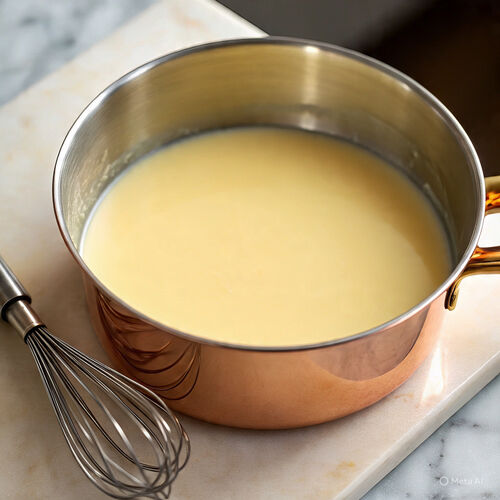
The liquid will morph from thin and pale to thick, smooth, and soft yellow.
If you start to see any bubbles around the edge of the pot, briefly remove it from the heat to prevent boiling while whisking.
Season and keep warm.
Season the sauce with salt and pepper, if you like, and use it right away or keep it warm until the vegetables are ready.
Toss the sauce with cooked vegetables or spoon it over top of them on a platter.
Because it's essentially just butter, it will solidify as it cools, but if you keep it warm it will stay fluid.
Servings\Yield
Makes about 5 Tbsp (enough for 2 pounds of vegetables)
Nutrition Facts
Nutrition Per Serving (2 tsp) - Calories: 68; Total Fat: 8g (Saturated Fat: 5g); Cholesterol: 21mg; Sodium: 1mg; Total Carbohydrates: 0g (Dietary Fiber: 0g, Sugars: 0g); Protein: 0g; Calories from Fat: 68 (100%)
*Nutrition information is provided as a general estimate only. Nutrient information is not available for all ingredients, and is based on available nutrient data. Variations may occur based on ingredient brands and preparation methods.
💬 Uncle Dave says...
Tips for Making Beurre Monté
You can fix it if it has separated. Ideally, a fully emulsified sauce will stay smooth even as it cools (as long as it doesn't boil), but a small bit of separation can happen — and it's totally OK. If the beurre monté is still warm, try vigorously whisking it back together first, as it sometimes just needs a little manual encouragement to stay together. If it has cooled, gently warm it over low heat while whisking constantly, but avoid high heat or boiling which just promotes further separation.
It's easy to flavor. Although the simplicity of the sauce is partly why I love it so much, you can easily flavor it, just like in my recipe for Caesar butter. For some acidity, add a tablespoon of fresh lemon juice with the water at the beginning of the recipe, or stir in some spices, finely chopped fresh herbs, or minced garlic while the beurre monté is warm.
Save any leftover sauce — even if it separates. Because you need enough liquid to properly whisk, it's hard to make a tiny batch of beurre monté. Because it's essentially just butter, you can save any extra in a food storage container in the refrigerator. Use it to cook with the same as any other butter (although I would skip baking projects due to the added water).
Salted, unsalted, cultured, or European butter all work. I prefer starting with regular, unsalted butter so I can season it to my own liking, but the technique is the same if you prefer salted butter, the tang of cultured butter, or extra-rich European-style butter.
From The Kitchn.
🧑🍳 The Cook:
Dave Ferguson
🔑 Keywords:
butter,
sauce,
french,
vegetables,
emulsion
🗂️ Categories: 🥐 French, 🥣 Sauces & Stocks, 🍅 Veggies, 🤯 Tips & Hints, 💡️ Tips for Meat & Seafood, 💡️ Tips & Hints for Everyday
📚 Collections: Uncle Dave's Cookbook, The TFR Cookbook
How to Make Beurre Monté was added on July 11, 2025 and last updated on July 11, 2025.
🗂️ Categories: 🥐 French, 🥣 Sauces & Stocks, 🍅 Veggies, 🤯 Tips & Hints, 💡️ Tips for Meat & Seafood, 💡️ Tips & Hints for Everyday
📚 Collections: Uncle Dave's Cookbook, The TFR Cookbook
How to Make Beurre Monté was added on July 11, 2025 and last updated on July 11, 2025.
*Serving suggestion only. 😂 If a food photo doesn't look like it was taken by a monkey named Frank, it was most likely AI generated and not the result of Frank's minimal culinary or photographic skills. Unless you failed the "I'm not a robot" test, your recipes will probably not look like the ones in the pictures. See Creamy Turkey Veggie Soup to read more about AI images.
📄 A Quick Note About The Recipes At The Ferguson Recipes: We love sharing recipes, but please be aware that most haven't been professionally tested in our kitchen or independantly verified. Your safety is important to us, so always practice safe food handling and cooking techniques. Cook smart and use your best judgment! Eggs: If you make a recipe that uses raw eggs, please consider using pasteurized eggs. Allergens: Food allergens have not been identified in each individual recipe. Please use caution if you have any food allergies. Have questions about a specific recipe? Feel free to reach out to us.
💡️ Cookie Policy, Privacy Policy, Disclaimers, and Terms of Service
🍪 Cookie Policy: Cookies are only used for registered users for the keep logged-in function, if you select it. They are also used to let us know that you don't want cookies set. Ironic, ain't it!
🤐 Privacy Policy: I don't share your information with anyone; I don't even know how!
📜 Terms of Service: Be nice!
ℹ️ About TFR: Click me to learn more about The Ferguson Recipes!
🏛️ Founded April 13, 2006
©️ 2006 - 2026 fergusonrecipes.com
📧 Contact!
🤐 Privacy Policy: I don't share your information with anyone; I don't even know how!
📜 Terms of Service: Be nice!
ℹ️ About TFR: Click me to learn more about The Ferguson Recipes!
🏛️ Founded April 13, 2006
©️ 2006 - 2026 fergusonrecipes.com
📧 Contact!
📄Recipe Disclaimer: While The Ferguson Recipes strives to present reliable and delicious recipes, please note that most of the recipes on this site have not undergone rigorous testing or independent verification. For this reason, we strongly recommend that you always follow standard food safety guidelines when preparing any dish. Eggs: If you make a recipe that uses raw eggs, please consider using pasteurized eggs. Allergens: Food allergens have not been identified in each individual recipe. Please use caution if you have any food allergies. If you have any questions or concerns about a specific recipe, please feel free to contact us.
🔎️ About Searches
- ‼️ Please enter at least 3 characters with at least 1 letter. (50 character limit.)
- 🍏 Use quotes for exact match (e.g.,"apple pie")
- 🍲 Use + to require words (e.g.,+chicken +rice)
- 🥩 Use | for "OR" (e.g., beef|chicken)
- 🚫 Use - to exclude (e.g., chocolate -nuts)
- 🌟 Use * as a wildcard (e.g., chick*)
- 🥣 Combine filters
- 🥣 Try (e.g., +Mexican +taco* -rice)
- 🥣 or (e.g., +"green beans" +ferguson)
- ⚠️ Some special characters might be ignored.
- 🍪 Search by category (e.g., sweets|cookies)
- 🧂 Search by ingredient (e.g., cinnamon, nutmeg)
- 🔍 Try multiple words for better results
- 🛑️ NOTE: One or more "-" without anything else will find no recipes.
- ⚠️ Occasionally, the highlighting process breaks due to embedded hyperlinks, some wierd characters, some weird punctuation, sun spots, acne spots, etc. Nowt to be done about it.
✖
![Zoomed image]()